
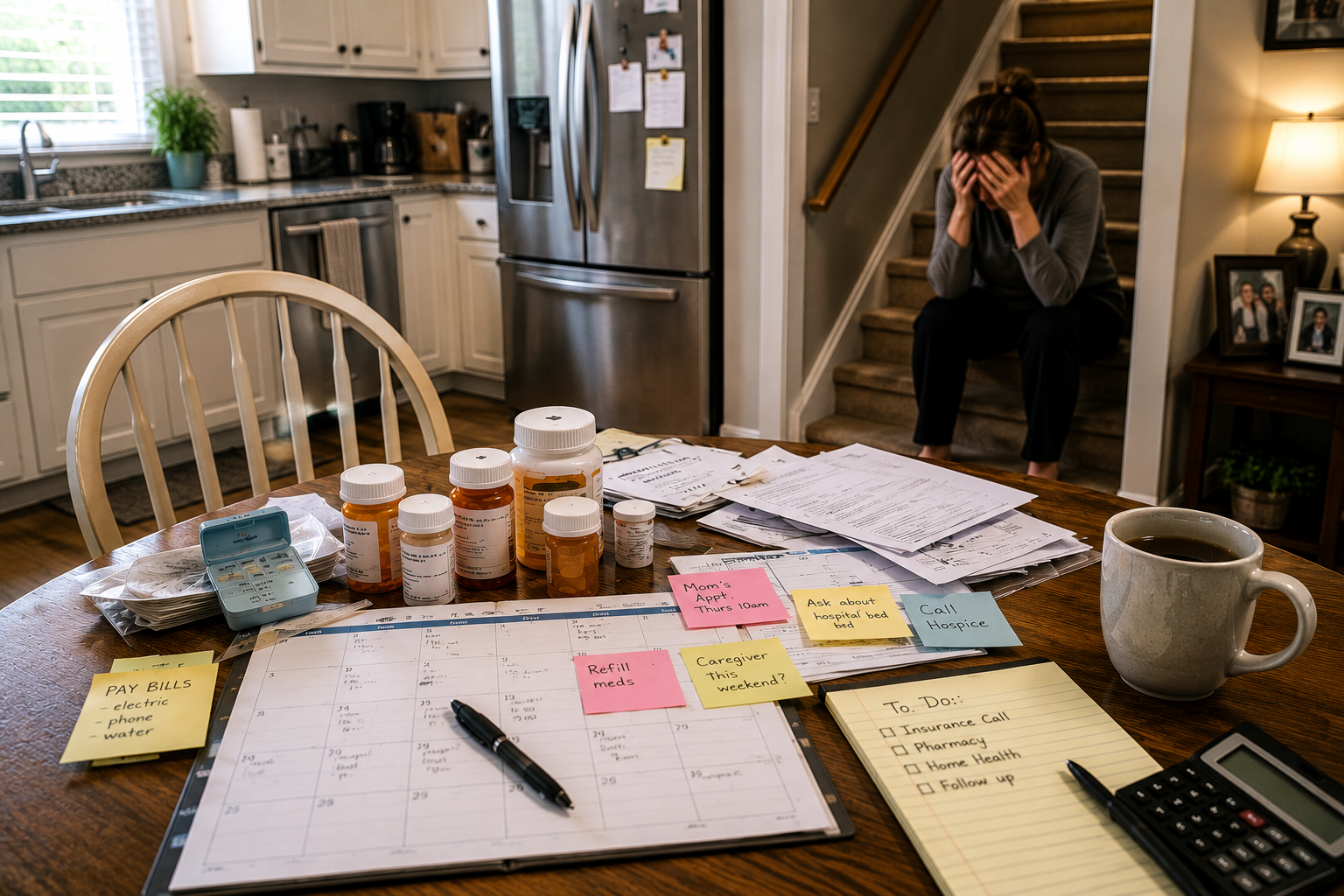
Nobody wants to talk about this. And I get it — death and dying make people uncomfortable. Planning for the possibility that you might one day need someone to wipe your face, feed you and help you to the bathroom? Even more uncomfortable.
So, we don’t talk about it. We plan for retirement. We contribute to our 401(k)s, open up IRAs, we meet with financial advisors, we worry about whether our savings will outlast us. But there’s one number — one enormous, life-altering number — that almost never makes it into the calculation.
The cost of caregiving.
Not just in dollars, though the dollars will take your breath away. I’m talking about the cost paid in years. In careers abandoned. In marriages strained to breaking. In adult children who quietly stop living their own lives so they can start living someone else’s.
I recently came across something a caregiver wrote online that I haven’t been able to shake: “My parents never made a plan. I became the plan.”
In over 30 years of working in healthcare — Naturopathic medicine, massage therapy, and now as a Patient Advocate and End-of-Life Doula — I have watched that sentence play out more times than I can count.
What People Actually Believe (And Why It’s Wrong)
Most people walk into a serious illness — their own or a loved one’s — with a set of assumptions that are almost entirely wrong. They assume Medicare will cover the care they need. It won’t — not the ongoing, day-in-day-out assistance with bathing, dressing, medications, and meals that real caregiving requires.
They assume their insurance will pick up the slack. Generally, it doesn’t — not for custodial care.
And then there’s the one that catches nearly everyone off guard: they assume hospice provides round-the-clock care.
It does not.
Hospice nurses visit. Hospice aides visit. Social workers visit. Chaplains visit. It is a remarkable service, and I recommend it wholeheartedly — I wrote an entire book about how to choose the right one. But hospice does not put someone at the bedside twenty-four hours a day. That responsibility still falls on family members, or on privately hired caregivers.
In the past several months alone, I’ve helped multiple families figure out what caregiving was going to look like in the final chapter of a loved one’s life. The first question they always ask is some version of: how much is this going to cost us?
Depending on where you live and how much assistance is needed, professional caregiving runs anywhere from $20,000 to $40,000 a month. Sometimes more. Families who spent decades carefully saving are stunned to watch those savings disappear in a matter of months.
But here’s what I’ve learned: the money, as brutal as it is, is rarely what breaks people. What breaks people is watching a spouse disappear from exhaustion, a daughter sacrifice her own future, or a family slowly unravel under the weight of responsibilities they never expected to carry.
The Problem Nobody Made
There’s something we need to talk about honestly, because it’s the thing we don’t talk about nearly enough.
Our medical system is very, very good at keeping people alive.
It is considerably less thoughtful about what that life looks like.
There’s an old clinical saying — “pneumonia is the old man’s best friend” — that sounds callous until you understand what it means. For generations, pneumonia was the illness that came quietly at the end of a long life and provided a relatively peaceful exit. Now we treat it aggressively. We treat most things aggressively. Infections. Organ failure. Falls that break hips. Strokes that steal speech and mobility. The Hail Mary is almost always on the table, and families — terrified, grieving, hoping — almost always take it.
I understand why. When someone you love is dying, you want to do something. You want to fight. Walking away from a treatment option feels like giving up.
But here’s the reality I see in my work: those Hail Marys often don’t cure anything. We are not curing cancer. We are not curing dementia. We are not curing congestive heart failure or end-stage COPD. We are extending a trajectory that was already pointing in one direction. And in doing so, we sometimes extend suffering — not just for the patient, but for everyone around them.
What we’ve created, often unintentionally, is a growing population of people living longer with significant disability, dependence and complex care needs. Not well enough to live fully, not sick enough to die quickly. Needing help with every basic function of their existence, sometimes for years. Decades.
And someone has to provide that help. Every single day.
Who Actually Becomes the Caregiver
It’s usually not who planned on it.
It’s the spouse who didn’t see this coming — who is now in their seventies or eighties, managing their own health problems, suddenly responsible for medications, appointments, bathing, meals, middle-of-the-night emergencies. I’ve seen spouses who haven’t slept through the night in eighteen months because they’re listening for movement from the next room. And when that spouse is the one who dies first? The kids inherit everything. The decisions, the debts, the parent who now can’t be alone.
It’s the daughter who lives the closest, who started by driving her mother to appointments once a week and gradually — so gradually she didn’t notice it happening — became a full-time caregiver. Who cut her hours at work. Who missed her kid’s school play. Who stopped returning calls from friends because she was too exhausted to explain what her life had become. Who moved mom into her house.
It’s the son who took his parents in “just temporarily” and watched temporary turn into three years.
It’s the sibling who lives far away, who shows up in a panic and tries to undo in a long weekend what everyone else has been managing for years. (American medicine actually has a name for this — “Daughter from California Syndrome” — which tells you how common it is.)
These caregivers lose wages. They lose retirement contributions. They lose promotions, opportunities, sometimes marriages. They often develop serious health problems of their own while being too busy to notice. The financial impact on a family caregiver, when you add up everything over years, routinely runs into the hundreds of thousands of dollars. None of that shows up on a retirement calculator. None of it is reimbursable.
The Conversation That Changes Everything
The biggest problem isn’t that caregiving is expensive. It isn’t even that our medical system has made it more necessary than it’s ever been before.
The biggest problem is that most families never talk about it.
They talk about wills. They talk about who gets the china. They talk about documents and accounts and inheritance.
But they don’t talk about this: What happens if one of us needs around-the-clock care for two years? What if it’s five years? Dementia alone can be a 10-year process. Who does that? What does it cost? What happens to the person doing it? What if we can’t afford professional help? What are we actually willing to do — and what would we want done for us?
Those conversations are hard. They require sitting with the reality that you are going to age, that your body is going to fail, that the people you love will be affected by how that happens and whether you’ve made any plan for it.
But avoiding the conversation doesn’t make the need disappear. It just guarantees that the decisions get made in a crisis — when everyone is scared and exhausted and not thinking clearly — instead of before one.
What I Want You to Take Away From This
I’m a Patient Advocate and an End of Life Doula. My whole practice exists because people find themselves in the middle of a healthcare situation they weren’t prepared for, and they need someone in their corner who understands how the system actually works — not how they assumed it worked.
I see this particular problem — the caregiving gap — more than almost any other. Families who planned carefully for retirement but never planned for this. Spouses holding everything together alone, past the point they should have asked for help. Adult children trying to manage from three states away with no idea what resources exist or how to access them.
If any of this sounds familiar, I want you to know: you don’t have to figure it out alone.
But even more than that, I want you to talk to your family now, before you’re in the middle of it. Ask the hard questions. Find out what your parents have in place — or don’t. Tell your own children what you want. Think about who will step in if you can’t care for yourself, and what that will realistically cost, both financially and emotionally, for those around you.
It’s one of the most loving things you can do for the people who will be standing next to you when it matters most.
Because everyone has a plan. Some plans are made on purpose. The rest happen by default — and someone else pays the price.
Melissa Wood is a Patient Advocate and End-of-Life Doula at Peaceful End of Life, serving clients in North Texas and virtually across the U.S. and internationally. She is the author of How to Choose the Right Hospice: A Compassionate Guide for Families. To learn more or schedule a consultation, visit PeacefulEndofLife.com.


